The PharmaCampaigns Take · Activation
The confident start: what turns a medical device sale into a device someone uses as it needs to be used?
Monitoring that once belonged in a clinic now happens at a kitchen bench. Sensors worn continuously for a fortnight and then replaced with the next one. Devices picked up every morning, or several times a day, designed so that an ordinary person on an ordinary morning can do something a health professional used to do for them. Consumer health devices have moved a long way, and they have moved in one direction: out of the clinic and into the home.
More people are monitoring more of their own health at home than at any point in the history of the health system, and the number rises every year. The defining feature of almost all of it is repetition. These are not devices used once and put away. They are used tomorrow, and the day after, and the pattern they build is the whole point of them.
Access is changing lives, quietly
This is one of the genuine good news stories in health, and it rarely gets told as one.
A person monitoring their own numbers between appointments makes different decisions from a person who sees them twice a year. Changes in a condition show up when they happen rather than at the next appointment. People stay independent for longer, manage more of their own care, and travel less to do it. In diabetes, where continuous monitoring has moved fastest, the shift is already visible in how appointments are run.
The larger shift is what this does to the consultation itself. Clinicians increasingly walk in already holding a month of patient-generated health data instead of a conversation about how things have felt, and they adjust treatment on it. A category of clinical evidence now exists that is produced entirely outside the health system, by the person themselves, on a consumer health device they set up at home.
The reverse is just as consequential. A clinician expecting a month of data and receiving none is worse off than one who never expected it, because the appointment was built around information that did not arrive. The device did not fail and the person did not stop caring. They stopped because the first week was harder than they expected, and nobody was there to make the second one easier.
None of this comes from the device sitting in the drawer, and none of it is any better than the way the data was generated. All of it rests on the device being used as designed, repeatedly, by someone who is comfortable using it.
Which puts a great deal of weight on one moment
For most of these devices, the moment they enter someone’s life happens in a community pharmacy.
It is the one point where the person is holding the device, the packaging is open, and a health professional who knows the product is standing in front of them. No appointment, no waiting list, no referral. Anyone who has watched a good handover has seen what pharmacy does with that moment: the box opened rather than handed over, the first step demonstrated rather than described, the question answered that the leaflet never anticipated.
Pharmacy teams are a large part of why home devices work as well as they do. They are also, in most cases, the only health professionals who will ever see the device in that person’s hands.
And a pharmacy is a busy place, with a great deal to hold
The care is not in question. The conditions are.
A community pharmacy carries hundreds of device lines from dozens of manufacturers, each with its own set-up sequence, consumables, replacement cycle and, increasingly, its own app. Packs are revised and models are superseded without anyone in store being told what changed this time. All of that sits alongside a queue that does not stop, a phone ringing, scripts to check and substitutions to explain.
No professional in any field carries that many product-specific sequences in their head and brings exactly the right ones to mind, for exactly the right model, on the spot, while three other things are waiting. That is not a memory failing. It is a volume problem, and volume problems are not solved by asking people to try harder or by sending another module.
Acquisition is one thing, a confident start is another
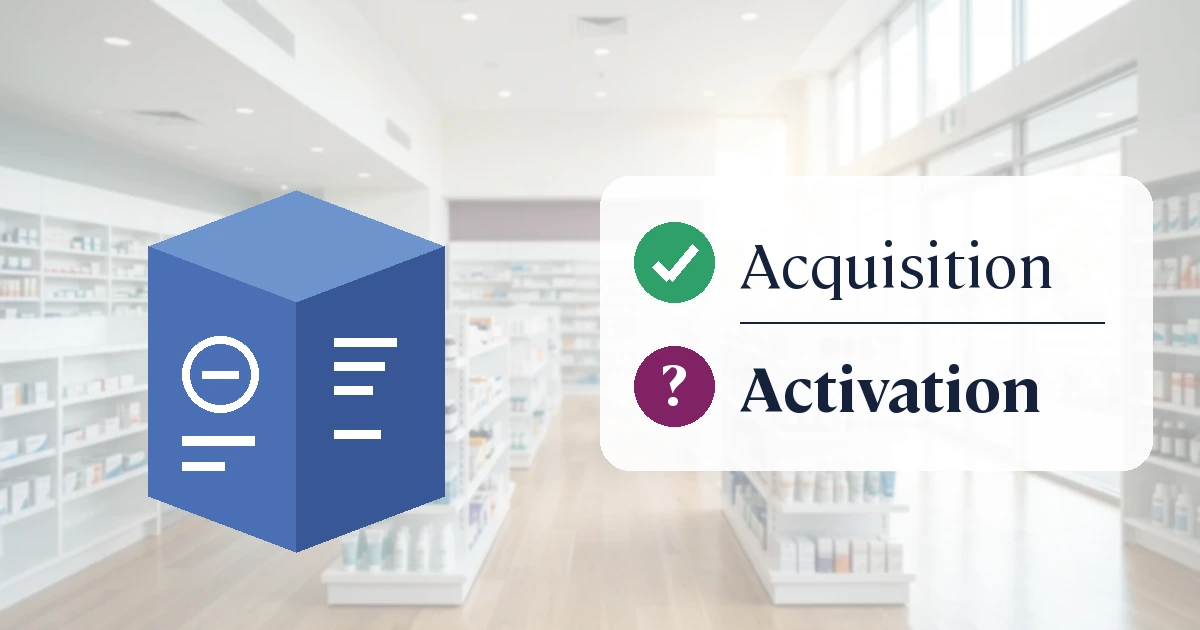
Two things have to happen when a device leaves a pharmacy, and only one of them is counted.
Acquisition is the handover. The right product chosen, paid for, in someone’s hands. It is visible, it sits in the sales data, and nearly all the commercial effort in the channel goes into making it happen.
Activation is what happens next. The person gets home, opens the box without hesitating, sets the device up correctly, and is still using it properly in week six. It is the point at which a purchase becomes a device being used the way it needs to be used. Nothing counts that. No line in any plan asks whether it happened.
For a manufacturer there is a commercial version of the same fact. In monitoring, the device is rarely where the value sits. The value sits in what follows it: the sensors, the consumables, the replacements and the subscriptions, none of which are bought by a person who has quietly stopped. A recurring revenue line is a bet on continued use, and continued use is decided long before the first reorder.
With monitoring, the stakes of that first set-up are higher than they look, because nothing about it is a single event. A habit formed in the first ten minutes is repeated every day for as long as the person uses the device. Get it right and every reading after it is worth something. Get it slightly wrong and the mistake is not one bad result, it is a month of patient-generated health data that looks exactly as credible as the good kind, and gets treated that way. Or there is no month at all, because the device stopped being used in week two.
We know how often starts go astray
The best documented case is respiratory, because it has been studied for longer than any other. A systematic review of studies that observed inhaler technique directly found optimal technique in around 31 per cent of people, and that this had not improved in forty years. Australian work found that confidence is no guide either: among users sure their technique was correct, six in seven were mistaken.
Forty years, and the instructions were in every one of those boxes the entire time.
Knowing a step and reliably performing it are not the same skill, and the second one cannot be posted.
The videos are excellent, and that was never the problem
Manufacturer demonstration videos are now better produced than most clinical training. If a content gap ever existed, it has been closed.
A video is available. A video is not present. It cannot see the sensor going on the side the person sleeps on, or the consumable that has sat open in a humid bathroom since March. It certainly cannot see any of that on day nine, when the routine has set. A confident start needs someone who can watch and correct, once, at the right moment. Content cannot watch.
Step-wise guidance, at the moment it is needed
This is where PharmaCampaigns plays a role, and the design brief is narrow on purpose.
The Portal sits behind the counter, staff-side, with the language and the steps for that specific device set out in order: which variant suits this person, which steps to demonstrate, the one thing to watch them do, what to say about the first week and when to come back. Nothing has to be held in memory, so nothing gets missed.
The pharmacist or the assistant does exactly what they would do anyway, with the detail already in front of them instead of somewhere in a folder. The record confirms it happened, so the work becomes visible to the brand that needed it, and the store is paid for the professional time it took.
The device is not only acquired. The person leaves with a confident start.
Why this only works inside quality use of medicine
Every prompt we design starts from patient benefit. A start-up prompt exists to make correct use more likely, never to move a unit. If the right answer for the person is a different size, a different device or no device at all, the pharmacist takes the conversation there, and nothing in the design should make that harder. Staff can decline any task. Fees are paid for professional service time, to the pharmacy as a business, never for an outcome.
Quality use of medicine has always covered more than tablets. It covers whether a person can actually use what they have been supplied.
The question to take to your next brand review
Ask one question of your current plan: how much of what you spend gets the device into someone’s hands, and how much helps them start using it confidently?
For most device brands nearly all of it goes to ranging, price, visibility and the sale itself. Almost none goes to the few minutes that set the routine every reading after it depends on. The people who could close that are already standing there, already willing, and already the last professionals to see your product before it enters someone’s home. What is missing is the brief, the steps and the record.
See what a confident start looks like.
A 20-minute call maps your device range against a single split: what gets it into someone’s hands, and what gets them started with confidence. We will show you where the second half is missing on your own lines, and what a demonstrated start is worth.