
The PharmaCampaigns Take · Category POV
Anatomy of a sales call: what separates a great one from a good one?
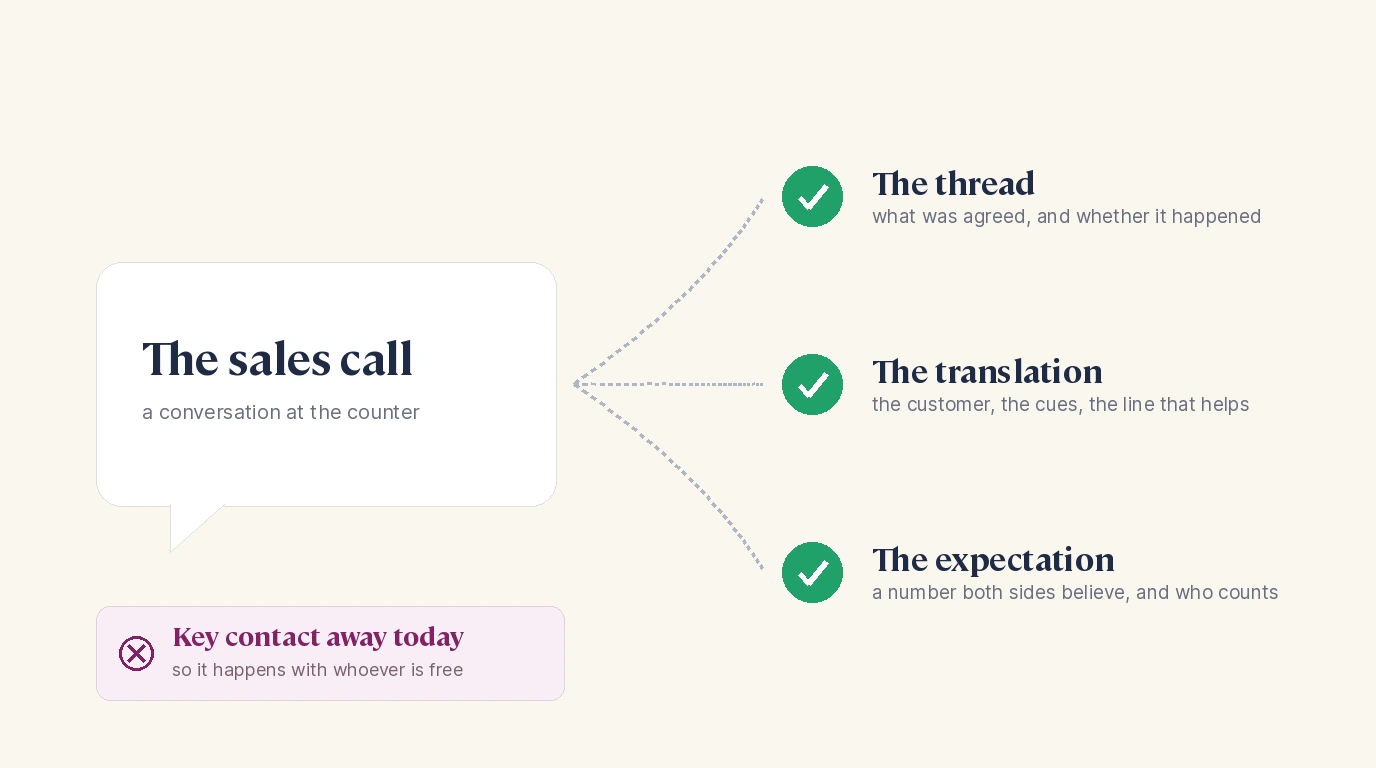
Two calls, same product, same brief, both delivered well. A month later one of them is still standing in the store and the other has gone quiet. Both were good calls. Only one of them was built to last the month.
It starts before the call does
Every category has a right person, and it changes by product. A front of shop line belongs to whoever owns the aisle and the recommendation that goes with it. A script-adjacent product belongs to the pharmacist, because the conversation happens at handover. An order belongs to whoever actually places it.
And then there are the champions. Almost every pharmacy has them, some nominated, most self-selected: the person who runs the NDSS terminal, the one who has become the diabetes go-to, the continence champion, the one who took an interest in wound management and now gets called over for every dressing question. They are rarely on any org chart, they hold the category knowledge in that store, and their colleagues route the hard questions to them without being told to.
Find that person and the call is a professional conversation rather than a product pitch. Miss them and the message goes to someone who will pass on a version of it, if the day allows.
A good call finds the right person. A great one knows who that was last time, whether they are still in the store, and whether the champion for this category has quietly become someone else.
One. It starts where the last one finished
A good call opens with the product. A great one opens with the thread.
What has happened in this store since the last visit. What was actually discussed, rather than what the brief said should have been. What was agreed, and whether it turned out to be harder than it sounded from the car park. Whether the display went up and came down again, whether the team ever saw the material, whether the person who agreed to it has since moved to a different store.
This is the difference between a store being covered and a store being visited.
Which makes the thread a record, not a memory. Every field team already knows this, which is why the CRM exists and why call notes get written up in the car park. The last conversation, the objection raised, who agreed to what: written down because next time depends on it.
Two. It translates the message into the store’s workflow
The message is about the product. The translation is about the person standing in front of the counter.
Who is the customer for this, actually. What are they living with, and what job does the product do for them that they cannot get done another way. How do they raise it, because almost nobody walks in and names a product. They describe a problem, or ask a question that is not quite the question, or hold something up and say does this work. Those are the cues, and knowing them is the difference between a product a team could recommend and one they do.
Then it has to become a story a pharmacy team can act on. Not a claim about the product, but a line about how this helps the person in front of them, because that is the core appeal of the profession and the reason most people in a pharmacy chose it. Help me help my customer is a proposition every pharmacist and assistant will make time for. Learn my product benefits is not.
And there is a second half, which is the store’s own case. What it does for the basket, whether it holds a customer who would otherwise go elsewhere, whether it brings someone back. That is not a crude question and pretending it does not exist helps nobody.
A message that has not been translated is information the store has to convert on your behalf, in the middle of a trading day, on top of everything else. A message that has been translated is a small change to something already happening.
Three. It ends with an expectation, not a thank you
The close of a good call is agreement. The close of a great one is a number both sides believe.
Not a request for support. A step the store can actually take, sized against what walks through their door. A customer already standing there who could be helped with a complementary product. A revenue line that stays once it starts, rather than one that spikes and stops. Given this store’s traffic, how many starts a month is realistic? Six? Twenty? The rep who has read the store has a view, and the pharmacist who works there has a better one. The number that matters is the one they agree on.
Then the second half of the question, which is the one most calls never ask. How will we know? Counted how, against what, looked at when?
An expectation with a number and a date is the only honest trigger for the next call. Without one, the return visit is scheduled by the route, which means by geography rather than by anything happening in the store.
A call with no expectation set has no natural next one. The route decides instead.
Then the week happens
Everything above is what a good call does. Now watch what happens to it.
The rep walks in and the diabetes champion is at lunch, or on a break, or off the floor for two hours doing something clinical and more important. The call still happens, with whoever is available, and a version of the story gets passed on later. Or not.
Then the next visit is due and the rep is on leave. Or the territory is being reallocated. Or the store slipped down the call plan because a bigger account needed the time. Stack it up: a store visited in March, missed in April because the right person was out, deprioritised in May, reached again in July. Four months with nobody carrying the thread, no story reaching the new starter, and nobody counting against a number that was agreed before any of it began.
Nobody did anything wrong. This is simply what a route made of individual people and individual diaries produces, and every field team in the country will recognise it.
The coordinator has advantages the rep does not
Here is the part that surprises people. On these three parts of the call, a PharmaCampaigns coordinator on the phone with the CRM open is not a downgrade. In places it is the stronger position.
They are reading the store’s record while they talk. The last conversation, the objection raised, the number agreed and by when, what was sent, what came back. Nothing is being held in memory between this store and the next twelve.
The Portal carries the translation, and carries it the same way into every store, as pharmacy sales support that holds between visits. The customer, the cues, the line that helps and the case for the store, told whole, in the same words, to whoever is on shift this morning rather than to whoever happened to be standing there in March.
And when the key contact is away, the call is tomorrow. Not next cycle, not next quarter. A phone call costs minutes rather than a drive across a territory, so the cost of missing the right person falls from months to a day.
Which makes this a feasibility question
None of this replaces the visit. The relationship, the negotiation, the read of the room, the argument that only works face to face: that is the field team’s work, and no screen builds it.
But the practical question is narrower than reps versus virtual coverage. Across 5,800 pharmacies, on a cycle measured in weeks, with leave, rosters and reallocation all doing what they do, can all three parts of a call be delivered everywhere, to the same standard, often enough to matter?
Coverage and variability are not performance problems to be managed harder. They are what a model built from routes and diaries produces. The only thing that changes them is a different model, running alongside the one you already have.
The question to take to your next channel review
How many of your stores got what you planned for them, and how many just got what the route allowed?
Give every call a thread to pick up.
A 20-minute call maps what your team already does well, and what has to sit behind them so it holds between visits.