
The PharmaCampaigns Take · Category POV
Winning the last three feet: whose conversation is it, and who starts it?
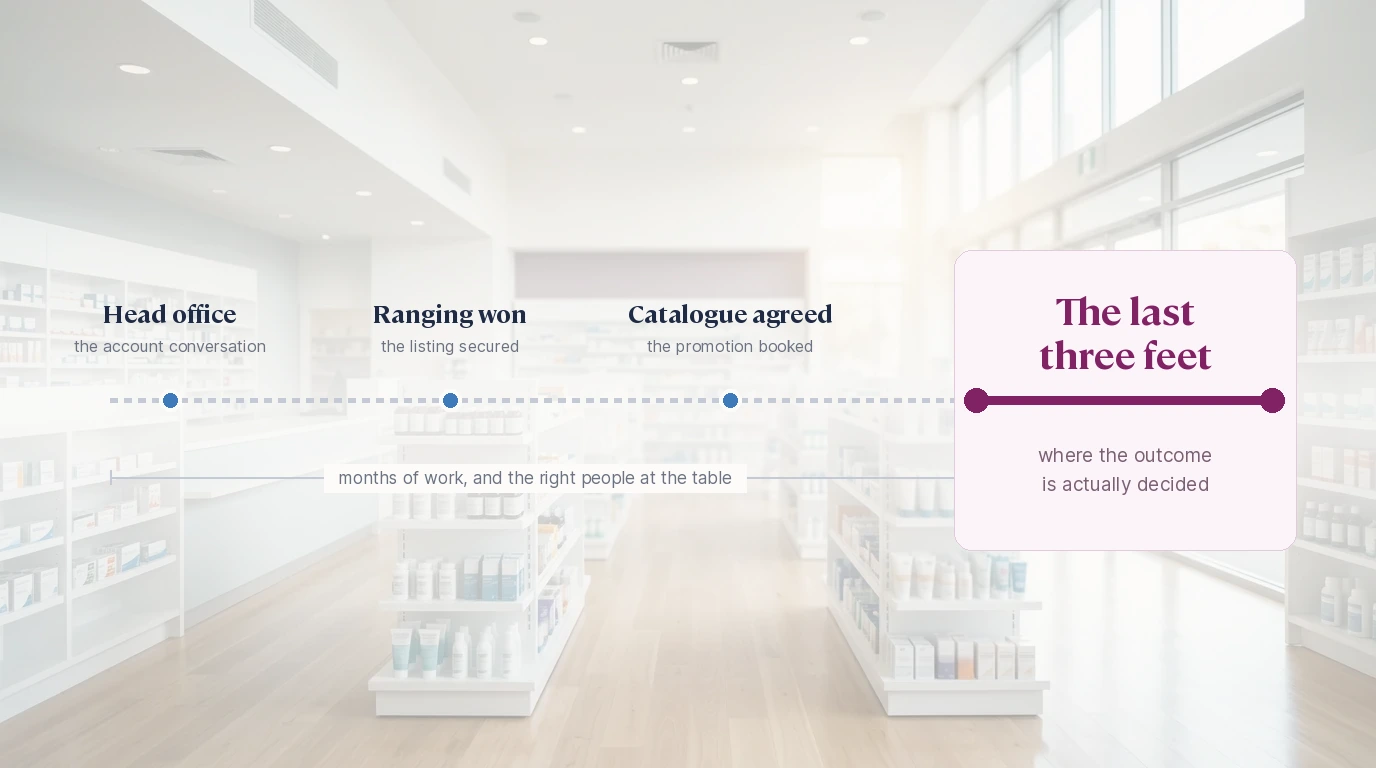
Ranging is won in head office, over months, by people who are very good at it. The catalogue and the promotion are decided somewhere else entirely, in the last three feet between a customer and the person behind the counter. Four things have to be true in that stretch, and only one of them is about your product.
The work that gets you there
Start by giving the account team its due, because the path into a pharmacy network is genuinely hard and it is walked by people who know exactly what they are doing.
A national or key account manager spends months on the head office relationship. The category story, the range review, the negotiation, the trading terms, the catalogue slot, the promotional calendar locked in for the year. That work takes real skill and real resource, and when it lands it is a substantial commercial win. The listing is secured. The promotion is booked.
And then the outcome of all of it gets decided in the last three feet.
Not because anything upstream went wrong. Because a catalogue price on a shelf edge and a recommendation from a professional are two very different propositions, and only one of them is decided in a boardroom. The account team can win everything available at head office and still watch the promotion underperform, because what happens in front of a customer was never in their gift.
One: decide whose conversation this is
The first question almost never appears in a brand plan. Where does this conversation actually happen?
If it belongs in the dispensary, it is a pharmacist conversation at handover. It is clinical in tone, it sits alongside a medicine the patient is already taking, the language matters, and quality use of medicines is the frame rather than a footnote.
If it belongs front of shop, it is a pharmacy assistant conversation at the shelf or the register. It is shorter, it is closer to a recommendation than a consultation, and it turns on something the customer has already said.
Different people, different moments, different sentences. A brand that has not decided which one it wants is asking the store to work it out during a trading day, and stores are not short of things to work out.
Two: give them the question that starts it
Attention is shortest exactly where it matters most. By the time a customer is standing in the store they are in the middle of doing something else, and the brand story that took a year to build has to survive compression into a sentence a person can say while doing three other things.
Almost nobody walks in and names your product. They describe a problem, ask a question that is not quite the right question, or hold something up and say does this work. Those are the cues, and between them and a conversation about your brand sits a gap that somebody has to cross. The customer will not cross it.
So the useful thing to hand a store is not a list of benefits. It is a trigger question. One line a pharmacist or assistant can ask, at a moment that is already happening, that identifies whether the person in front of them is a candidate for this conversation at all.
Get that right and nobody is selling anything. They are asking a professional question and responding to the answer.
Ranging is won in head office. The catalogue and the promotion are decided in the last three feet. I have watched accounts teams do everything right at the buyer table and then watch the result get set by whoever happened to be at the counter that week.
 Steve BrandtHead of Retail Commercialisation, PharmaCampaigns
Three: have the business conversation, not just the counter one
Here is the part most brands miss entirely, and it is not with staff.
Everything above is a conversation with the people at the counter. There is a separate conversation to be had with the business, and it belongs to the owner or the manager. What does this category represent for this store? What is the untapped potential sitting in their own numbers? What does it do for the basket, for retention, for the reason a customer comes back here rather than buying it in a supermarket?
That is a commercial conversation, not a product one, and it works differently. If the owner concludes there is a real opportunity in the category, the focus cascades. It shows up in what gets raised at a team meeting, what the store puts weight behind, what a new starter gets told in their first week. No amount of counter-level briefing achieves that, because the people at the counter cannot reset the store’s priorities. Only the person running it can.
Most brands run the first conversation hard and never have the second one at all.
Four: find the person who will carry it every day
The fourth is what makes the other three durable. Almost every pharmacy has its champions, some nominated, most self-selected: the person who runs the NDSS terminal, the diabetes go-to, the one who took an interest in wound care and now gets called over for every dressing question.
If your category has a champion in that store, the workflow decision, the trigger question and the business case all have somewhere to live. If it does not, they live with whoever happened to be standing there on the day you explained them.
None of the four can be done from head office
Look at what they have in common.
Deciding where the conversation belongs is a brand decision, but landing it is not. A trigger question only works if the person asking it has heard it, believes it, and has it to hand in the moment. The business case needs the owner rather than the counter. And a champion has to be found rather than assumed, because it is a different person in every store and it changes.
All four are execution, in a specific store, with a specific person, repeatedly. That is a far harder thing to buy than media or a promotional slot, which is why most brands spend upstream where the buying is straightforward and hope the last three feet takes care of itself.
None of this is a reason to hesitate. It is simply the work that sits on the other side of the ranging win, and the brands that do it well are the ones whose promotions perform when the catalogue drops.
Running it as a campaign
Here is the practical gap. The account team is not going to be in 5,800 stores, and for most brands there is no field force that gets close either. The stores still need the support, and the brand still needs the love.
This is what the always on layer is for. Campaign Coordinators call the store and reach the right individual, which is the whole game in the fourth part above: not the pharmacy generally, but the person who owns this category here, and the owner when the conversation is a business one.
The Portal carries the two things that make the counter conversation possible: what the category is worth to that store, and the key selling message compressed to a line a professional can actually use. Same message, same standard, in every store, in front of whoever is on shift.
And the campaign itself does the rest. A ninety second CampaignREEL introduces the brand to the whole team at the morning huddle. CampaignTASKS confirm the stock, set the shelf and photograph the result, every completion validated and time stamped. CampaignINTERVENTIONS prompt the recommendation conversation when a customer presents with the relevant need, which is the trigger question doing its job at the moment it was built for.
The question for your channel plan
For your lead product, can you say in one sentence who has the conversation, what question starts it, and what the category is worth to that store? And in how many of your ranged stores does anyone actually know all three?
Win the last three feet, in every ranged store.
A 20-minute call maps who should be having the conversation in your category, what question starts it, and what it is worth to the pharmacy.