The PharmaCampaigns Take · Activation
From blind handoff to meaningful sampling
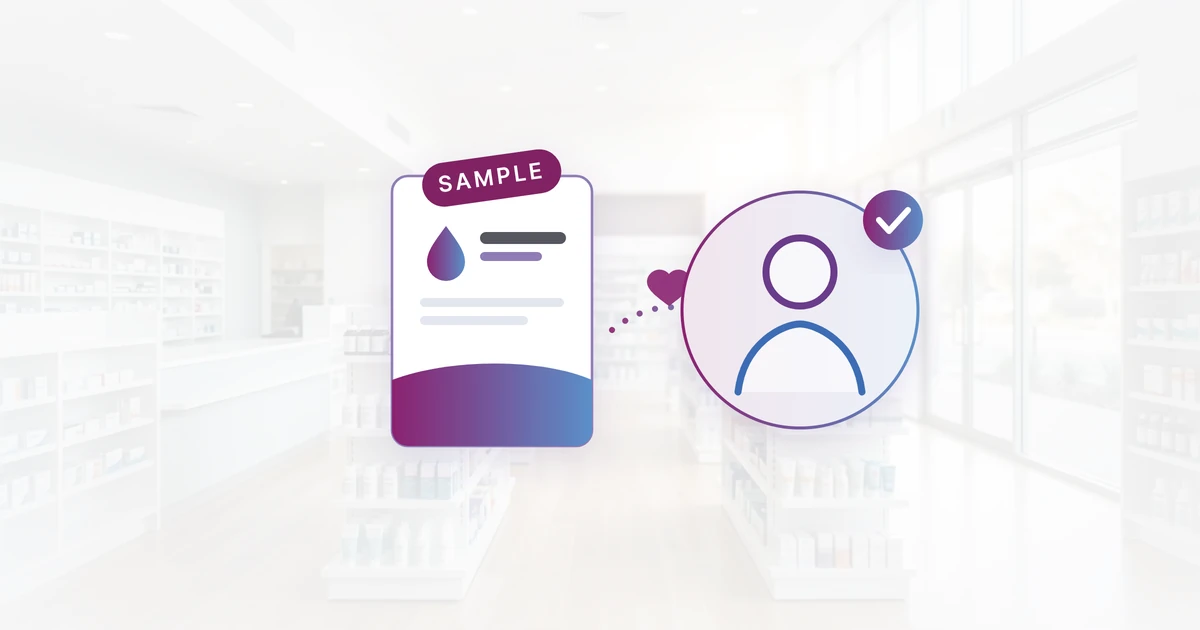
Free samples. It’s a tactic you know well to drive awareness and growth. It gets placed in the customer’s hands. What happens after that is usually unknown, as it is hard to track. Compare that to a Spotify Premium or LinkedIn Premium free trial. The platform knows the moment you start it, what you use during it, and whether you convert to a paid plan the day the trial ends or cancel before it converts. Nothing about that journey is a guess.
The blind handoff
Sales briefs complete. Pharmacies receive their stock. A physical sample handed over at a pharmacy will disappear the second the customer walks out the door. You know the volume. You don’t know the outcome. How do you track if this converted into a sale?
Which customers received it? The right customer, or whoever happened to be nearby? Were they provided product information, how to use it and how it helps them? Did it turn to a sale the following week or six months later? Did it sit in a drawer or only get used once?
For most brands, none of that is answered. Sampling gets measured by units distributed. How do you measure conversion and your return on investment?
Volume isn’t a metric. Conversion is.
The sample and the sale happen in two different moments, often months apart, often through different channels. Most teams find it challenging to connect them. Sampling will look like progress without proof.
That’s the coverage gap. And it’s expensive.
The psychology behind it
Trial converts for two reasons. Both are about what the customer feels, not what they’re told.
Ownership. Kahneman, Knetsch and Thaler’s 1990 research on the endowment effect found people value something more the moment they hold or use it. Trial creates a sense of ownership before any money changes hands. Walking away starts to feel like a loss.
Sense of control. Research on self determination theory and the “theory of trying” shows that trying a product on your own terms, with no pressure and no funnel, builds a sense of control that predicts whether trial becomes a purchase. A free choice feels like the customer’s own conclusion, not a sale.
Pharmacists are well placed to understand each customer’s needs and to support them in getting started with a product that is genuinely right for them. That professional support is what turns a sample into a meaningful trial.
 Charmaine Gutierrez
Marketing and Operations Lead, PharmaCampaigns
Powerful for brands
A pharmacy is in a unique position to know its customers: who’s been on the same product for years, who’s due for a review, who’s a genuine fit for something new. That proximity is what makes sampling powerful for switching. Instead of a sample going to whoever’s nearby, it goes into the hands of pharmacy staff who can match it to the right customer, at the right moment.
A claim on a page can be argued with. A pitch can be tuned out. But a product placed by someone who knows the customer, tried on their own terms, doesn’t need defending. It speaks for itself. When the right customer experiences it directly, the product does the convincing no message ever could.
Ask these before you sample again
- Did the sample reach someone with a genuine reason to try it?
- What happened after it left your hands?
- Can we trace that trial to a sale, or a lost one?
Most brands can answer the first. Almost none can answer the rest. That’s where the ROI is hiding.
What meaningful sampling looks like on the ground
This is the gap PharmaCampaigns closes. We target sampling to the right people, protect the autonomy that makes trial meaningful, and track what happens after, connecting that first moment of trial to the sale down the track.
If you can’t say what happened after the sample left your hands, you’re not running a sampling campaign. You’re operating on assumptions.
See what happens after your next sample.
A short call walks through one of your current sampling campaigns the way the customer experiences it: who it reaches, whether it converts, and what closing that gap looks like.