The PharmaCampaigns Take · Research
The sense check: testing your POS with the people who actually deploy it
Every brand manager has been through the cycle. A new claim is approved. The agency comes back with a wobbler, a jiggler, a shelf talker and a gondola end. There are rounds of feedback, a regulatory review, a print run, a freight schedule. By the time it lands in store, the investment is committed and the artwork is fixed.
And at no point in that cycle did anyone ask the pharmacist.
Not because brand teams do not care what pharmacy thinks. Because there has never been a fast way to ask. Community pharmacy is thousands of independent businesses. Reaching a few hundred of them to sense check a piece of creative has traditionally meant recruitment, panels, scheduling and a research budget that only the largest launches can justify. So the question gets skipped, and comprehension gets assumed.
The assumption hiding in every POS run
Point of sale material has one job. It has to mean something to the person standing in front of it, and it has to mean the right thing to the person standing behind the counter.
That second part is where the risk sits. A wobbler that reads perfectly in a design review can land differently on a shelf, next to four competitor products, under fluorescent light, at eye level or below it. A claim that is precise in regulatory terms can be ambiguous in conversation. A visual cue that is obvious to the team who spent six weeks with it may not be obvious to a pharmacy assistant seeing it for the first time on a Tuesday morning.
The pharmacist and the pharmacy assistant are not the audience for the creative. They are the channel for it. If they do not read it the way you intended, the shopper never gets the intended message either, because the counter conversation is where most category decisions actually happen.
What CampaignINSIGHT does
CampaignINSIGHT turns a creative sense check into a structured campaign task inside the Portal.
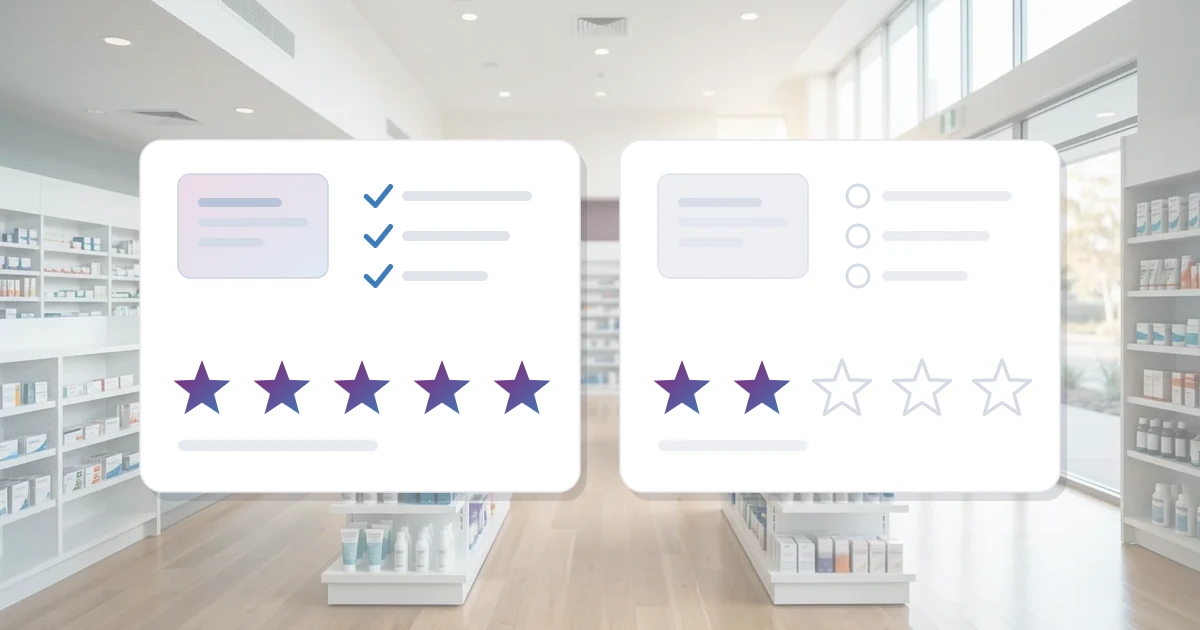
You supply the artwork, whether that is a concept, a near final proof or two routes you are choosing between. We put it in front of pharmacists and pharmacy assistants across the network as a short, structured task. They see the creative, answer a defined set of questions, and submit. Every response is validated and time stamped, and comes back to you as data rather than anecdote.
Because the network is already there and already active, this happens in days, not months. And because it runs through the same execution layer that delivers your campaigns, it costs a fraction of what a traditional qualitative round costs.
The questions worth asking
The value is in asking things that are usually left to assumption.
What do you think this product is for? Ask an open question before you ask a prompted one, and you find out what the creative actually communicates rather than whether people can recognise your intent when you hand it to them.
Which of these two routes is clearer? A forced choice between concepts, answered by hundreds of people who work the counter every day, is a far better basis for a print decision than a boardroom preference.
Would you feel confident recommending this based on what you can see here? Comprehension is one thing. Confidence to recommend is another, and it is the one that moves units.
Does the pharmacy assistant read it the same way the pharmacist does? This is the question almost nobody asks, and it is often the most revealing. The assistant is frequently the first conversation a shopper has. If the message lands differently for them, that is a gap you want to know about before the print run, not after.
Is there anything here you would change? Open feedback from people who see hundreds of POS pieces a year is worth more than most brand teams expect.
What changes when you know
The obvious value is avoiding an expensive mistake. Finding out that a claim reads ambiguously is considerably cheaper before the freight than after it.
The less obvious value is the decisions it unlocks. Choosing between two routes with evidence instead of instinct. Going to a category buyer with validated comprehension data behind the creative. Understanding which of your messages travels well through a counter conversation and which needs support. Building a picture, over several campaigns, of what community pharmacy actually understands about your category.
It also changes the relationship. Pharmacies are asked to deploy brand material constantly and are almost never asked what they think of it. Being consulted, and earning professional service remuneration for the time it takes, is a different kind of engagement from being sent a box.
Where it fits
CampaignINSIGHT is not a replacement for consumer research. It answers a different question. Consumer research tells you what the shopper thinks. CampaignINSIGHT tells you what the channel understands, which determines whether your message survives the journey to the shopper at all.
It sits naturally at three points. Before print, as a sense check on concepts or a final proof. Alongside a launch, to understand how the material is being received in the stores running it. And after a campaign, to understand what was understood, and what to change next time.
The material is going to be printed either way. The only question is whether you find out what pharmacy makes of it before that happens or afterwards.
Sense check your creative before the print run.
A 20-minute call shows how CampaignINSIGHT puts your artwork in front of pharmacists and pharmacy assistants across the network, as a structured campaign task in the Portal, with validated, time-stamped responses back in days.