The PharmaCampaigns Take · Category POV
The wound care statement: how does
best practice survive a busy shift?

Wounds APAC has published a Made Easy document of the 2025 Best Practice Statement on the role of the Australian community pharmacist in acute wound care. It’s a document worth celebrating, and it’s also a lot to carry in your head. Structure can share the load.
A statement worth celebrating
Community pharmacies are one of the most trusted front doors in Australian healthcare. For a cut, a burn, a bite or a skin tear, the pharmacy is often the first stop, well before a GP or an emergency department.
The 2025 Best Practice Statement, now distilled into a Made Easy by Wounds APAC, gives that reality a professional framework. It sets out what good acute wound care looks like in a community pharmacy, from the first question at the counter to the point a wound needs referral.
That recognition matters. It says, formally and in writing, that pharmacists are not just adjacent to wound care. They are part of it.
What best practice actually asks
In acute wound care, a pharmacist may be expected to:
- Assess, document, treat and triage wounds
- Select appropriate dressings based on wound characteristics and the patient
- Cleanse wounds, and apply or supervise and remove dressings
- Educate patients on treatment, dressing changes, healing progress and red flags
- Review medications and comorbidities that may impair healing
- Recognise when referral to another healthcare professional is needed
Behind each line sits real clinical depth: structured assessment across history, visual and physical examination and function; the line between acute wounds, more likely to sit within community pharmacy scope, and chronic wounds, which generally need referral; infection signs, obvious and subtle; medications that slow healing; dressing classes and when each applies; even how to remove an adhesive dressing without injuring fragile skin. It’s an excellent body of knowledge and a lot to retain.
The part nobody says out loud
A community pharmacist’s day is already full. Dispensing, counselling, vaccinations, scripts, staffing, a queue that never ends. Wound care arrives inside that, unannounced, one customer at a time.
Expecting every pharmacist to hold that training in full and recall it perfectly at four o’clock on a Saturday is a big ask. Pilots don’t fly from memory. Surgeons don’t operate from memory. They follow structure. Pharmacy should be no different.
This isn’t a one-off. It’s the direction things are heading. Scope of practice reforms in NSW and elsewhere are handing pharmacists more clinical responsibility: vaccinations, prescribing, chronic disease management, and now wound care. Each addition is reasonable on its own. Together, they compound the same problem: more expected, less room to hold it all in memory.
Pharmacists are well placed to deliver this level of care. What they deserve is structure that puts best practice on the screen in front of them, step by step, so nothing rests on memory alone.
 Charmaine Gutierrez
Marketing and Operations Lead, PharmaCampaigns
Structure beats memory
This is why PharmaCampaigns builds digital pathways. The Portal takes a best practice document like this one and turns it into a sequence of screens a pharmacist can follow, in order, in the moment.
A wound care pathway on the Portal guides the pharmacist through each step: capture the presentation, work through a guided assessment, cleanse, select the dressing that fits the wound and the patient, advise on home care and red flags, check for medications that impair healing, refer on when the wound calls for it.
Each screen asks for what’s needed and nothing more. Each step completes before the next opens. Every pathway completed on the Portal is validated and time stamped, so care delivered in store is visible, not assumed.
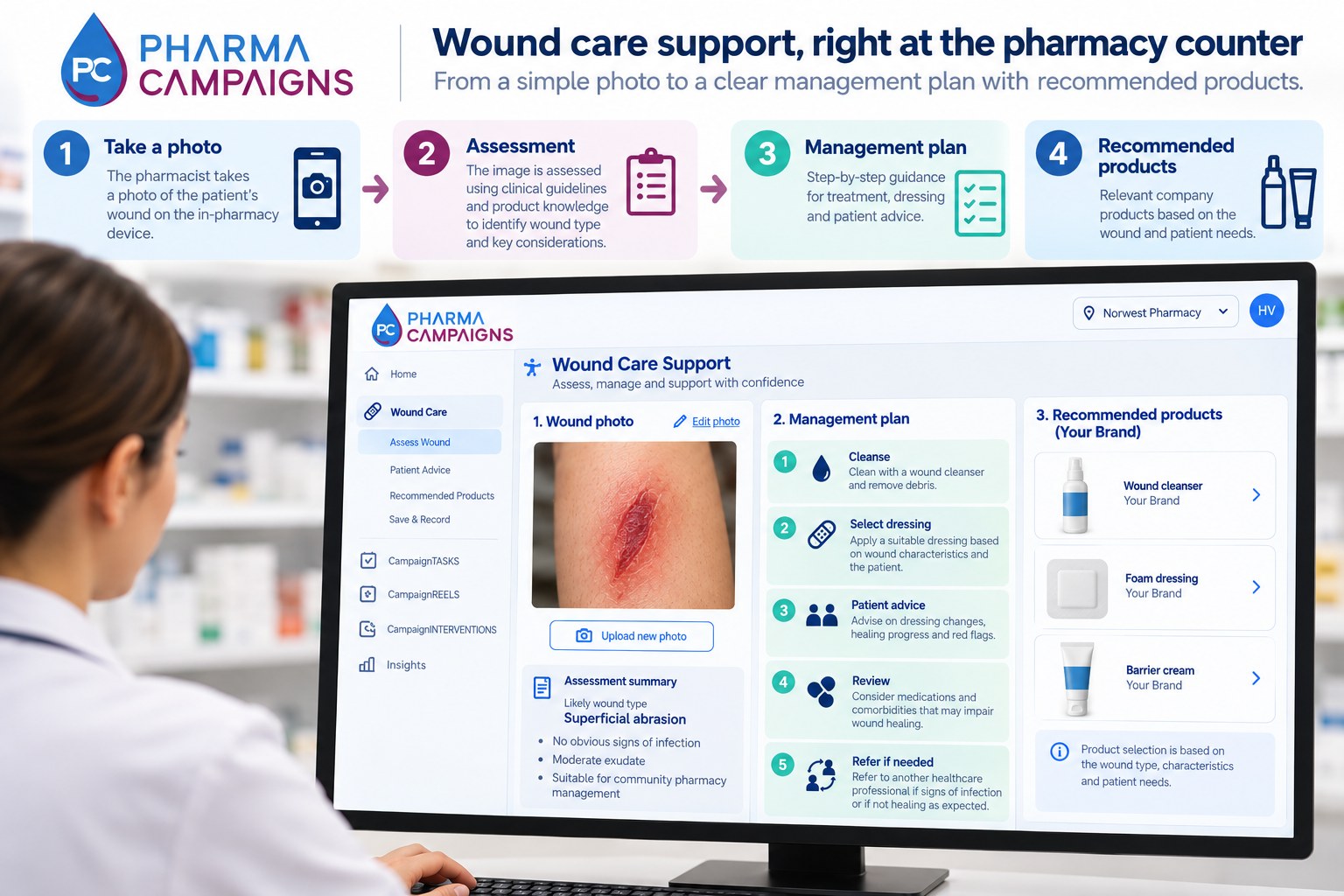
Training still matters. Professional judgement still matters. What changes is that the structure does the remembering, so the pharmacist can focus on the person in front of them.
For wound care brands
If your brand sits in this category, this statement is your moment. A campaign built around a guided pathway does more than place product. It supports pharmacists in delivering the standard the profession has just set for itself, with your brand present at the point dressings are selected and advice is given. That’s a very different proposition from a poster and a shelf talker.
The question worth asking
Best practice statements set the standard. Execution decides whether patients feel it. What would it take for this statement to run, step by step, in thousands of pharmacies, on the busiest day of the week?
We think the answer is structure. And we have built it.
Source: Wounds APAC, The Role of the Australian Community Pharmacist in Acute Wound Care Made Easy, August 2026, summarising the 2025 Best Practice Statement.
See what best practice looks like on the Portal.
A 20-minute call includes a walk through of a guided wound care pathway, and how a campaign for your brand would run on it.